The Person Who Would Make a Latex Scar for a Character in a Film Can Be Called What?
Bodily mutilation in moving picture describes the apparent mutilation for theatrical purposes of a character in a movie. Actual mutilation is most usually portrayed in the context of horror, only is too used in other genres, such every bit medical dramas or state of war films. It is used primarily either to daze or fascinate the audience of a film, or to add a sense of realism to a film. Improved special effects in contempo decades have seen an increment in the prevalence of actual mutilation in film.
Cursory history [edit]
Early years [edit]
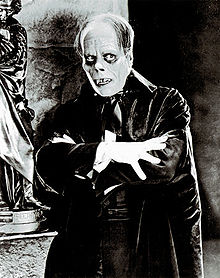
Lon Chaney as the phantom in the 1925 film The Phantom of the Opera
In the early years of motion picture history, horror was oftentimes used in order to attract and intrigue audiences. To affright and fascinate the audition was the goal. Lon Chaney was well known for his portrayals in various horror films, only the bailiwick in focus is his use of makeup to create his ghastly visages. He was known as "the human being of 1,000 faces." (Rickett 2000) Chaney was arguably one of the forerunners of makeup use in horror films. Some others include actors Boris Karloff and Lon Chaney Jr. But information technology was the man behind their makeup, Jack Pierce, who made them what they were (Rickett 2000). While these movie makers didn't make films rife with violence and mutilation, their influence on later moving picture makers was bully. Early on horror movies focused on suspense and monsters but equally realism has progressed, film makers have focused more than on realistically portraying the horrible fate of whoever is unfortunate enough to autumn victim to the fell devices.
Appearance of Horror [edit]
Although there was a boom of monster and alien flicks in the 50s and picture show makers using make up more than for realistic depictions of violence and gore in the 60s,[1] the advent of realism in horror as we at present know it arguably began with the 1973 film The Exorcist. This was the kickoff of its kind as far as special effects used realistically to portray gruesome scenes. This movie, created past director William Friedkin with make up chief Dick Smith directing the effects set up the stage for countless other such films to be made.[1] Afterward the release of The Exorcist and its subsequent popularity scary movies began to shift and the violent horror motion picture became a major genre. With effects greats Kevin Yagher, Dick Smith, and Tom Savini behind such classic horror films equally Fri the 13th (1980), A Nightmare on Elm Street (1984), Halloween (1978), and Dawn of the Dead (1978) this genre gained immense popularity (Rickett 2000). This craze peaked during the 80's went downwardly a niggling in the 90's only with the movie Scream (1996) horror movies were back in. Every bit special furnishings continue to get better, and so the horror films continue to grow even more violent, gruesome, and realistic in their portrayals of human mutilation as can be seen in the recent Saw films (2004,2005, 2006, 2007) too as others such as Hostel (2005) and Hostel: Part II (2007). Still horror films are not the only movies that have worked to realistically portray bodily mutilation.
War Films [edit]
State of war movies have often romanticized boxing and violence for glory; but afterwards the Vietnam State of war, many movies worked to portray war in its true form, all the violence, brutality, and even the psychological distress included. This is shown in several films including The Deer Hunter (1978) and Casualties of War (1989). A cracking instance is the classic film Saving Private Ryan (1998). In the offset of this motion picture there is a 15-infinitesimal scene showing the landing of American troops at Omaha beach. In this scene at that place are untold amounts of claret and gore as German language machine guns literally rip the U.S. soldiers apart achieved through bullet hit squibs. Other war movies such as Flags of Our Fathers (2006), Enemy at the Gates (2001), and Letters from Iwo Jima (2006) work to show the effects of battle on the man body.
Mod Media [edit]
Nowadays, y'all can find body mutilation in many unlike kinds of movies. Some of the more mutual examples are in movies or shows that describe hospital or law enforcement. As hospital and police movies and TV shows gain popularity and attempt to make the situation more than real, they have utilized techniques to brand operations and crimes as realistic equally possible. This includes breaks, burns, cuts, surgery, and violent attacks. This portrayal is often graphic, but authentic. Regardless of intent, movies take progressed profoundly from the early on years of Chaney and Pierce in the realistic portrayals of actual mutilation.
Notable names [edit]
Lon Chaney [edit]

Lon Chaney Sr., still from The Miracle Man (1919)
Although not a pioneer when it comes to mutilation, Lon Chaney was the inspiration for many moving picture makers who were. Born on April 1, 1883 in Colorado Springs, Colorado to deaf mute parents, Lon Chaney did not have the easiest childhood (Anderson 1997). Even so, this did not prevent him from becoming a magician with makeup. Throughout many various films, Chaney perfected his craft. He did his makeup for all the films he was in. Chaney'due south makeup kit gear up the standard for afterwards makeup departments in Hollywood.[2] While his nigh widely known films are The Hunchback of Notre Dame (1923) and The Phantom of the Opera (1925), possibly some of his nigh important contributions to modern horror films and their emphasis on the mutilation came from his work in lesser known films. For instance, Chaney used collodian to make realistic scars and deformities for his characters Singapore Joe in The Route to Mandalay (1926), Ricardo in Victory (1919), and Tiger Haynes in Where East is E (1929). Chaney died on August 26, 1930 in Los Angeles, California due to complications with throat cancer (Anderson 1997).
Jack Pierce [edit]
Jack Pierce did the makeup man behind popular monster creatures Frankenstein (1931), The Mummy (1932), and The Wolf Human (1941) (Rickett 2000).
Dick Smith [edit]
Born on June 26, 1922, Dick Smith is one of the near influential men on the art of makeup. As John Caglione Jr. put information technology, "No one will e'er take over for Dick Smith. In forty-five years of doing makeup, I don't remember anyone's touched him. He is the heavyweight champion of makeup (Timpone 1996)." Main of makeup, Smith helmed many movies' special effects, but he excelled in prosthetics and age makeup. Notable examples are that of Marlon Brando as the Don in The Godfather (1972) and F. Murray Abraham as Salieri in Amadeus (1984). He also did age makeup for Max von Sydow every bit Father Merrin in The Exorcist making this 44-year-sometime await 74 (Multimedia Publications 1986). In this movie he made possibly his greatest contribution to modernistic mutilation technique with the 360° turn of Linda Blair'due south caput. This scene complete with vomit spewing and severe facial distortions prepare the bar for future film makers. Although possibly his greatest contribution to horror, information technology was non his last. He later worked on other films including the 1977 film The Watch in which he coordinated the furnishings for a gruesome nose and eye slashing (Timpone 1996) among other things.
Tom Savini [edit]
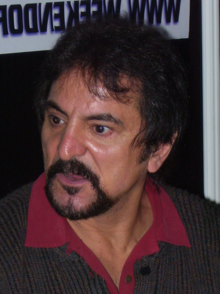
Known equally the King of Splatter (Rickett 2000), Tom Savini has quite a reputation for his work in horror movies much of which has included astringent bodily mutilation in many circumstances. According to Anthony Timpone in his volume Men, Makeup, and Monsters, Savini started his career immature. Earlier makeup artists provided him with inspiration. "Lon Chaney became a hero," he said.[3] Drafted into the military during the Vietnam War, he became a combat lensman. He would do his craft on the men he was with, but also got a taste of truthful gore. "I've seen the existent stuff."[4] While in Vietnam, Savini saw many gruesome sights including bodies in rigor mortis and even a dismembered arm. This may take provided him with textile he would later use in his movies. And he did utilize gore and violence in his movies. Peradventure this is stated all-time by Timpone.
"Prior to Savini'south piece of work on Dawn of the Expressionless, realistic screen slaughter had rarely gone to the unrated extremes it would soon accomplish in the early on 80s with Savini'due south guidance. Via his macabre tricks, heads were severed, scalped, axed, exploded, and pierced. Machetes hacked off limbs, fangs tore through chunks of human flesh, and blood numberless sprayed gallons of grue. Zombies, ghouls, demons, hideously disfigured maniacs, and other contrasted Savini-created monsters racked up countless body counts." [four]
This chief of splatter was behind many horror films' effects including Martin (1978), Maniac, Friday the 13th (1980), Fri the 13th: The Last Chapter (1984), Day of the Dead (1985), The Texas Chainsaw Massacre ii (1986), and Two Evil Eyes (1990). "My task is to create the stuff as realistically as possible." [iii]
Rick Baker [edit]
Rick Bakery is known mainly for his work making ape films (Timpone 1996). However, he is well known for his work on An American Werewolf in London (1981), specifically the on screen transformation of the chief character into a werewolf (Multimedia Publications 2986). While this may not be considered mutilation, the transformation is a radical alter from homo to monster and therefore evokes many of the same emotions.
Kevin Yagher [edit]
Mastermind behind the psychotic doll Chucky, Kevin Yagher is known for his piece of work with animatronics (Timpone 1996). He also did effects for the Nightmare on Elm Street movies 2-4.
Bob Keen [edit]
Bob Keen did effects on the movies Hellraiser (1987) and Nightbreed (1990)
Greg Nicotero [edit]
Movies and television receiver shows [edit]
The Exorcist (1973) With the Linda Blair head turn and accompanying effects, this film inspired many film makers.
Martin (1978) The scene where Martin, the title character, slits the wrist of an unconscious girl shows a flim-flam used to fool the audience into assertive in the realism of the activity.
Dawn of the Dead (1978) This film was very original. In fact, according to effects human Tom Savini, this moving picture was largely improvised during its making. "We'd be sitting effectually thinking of ways to kill a zombie." These ways include stabbing ane in the ear with a screwdriver, and cutting one'south head to pieces with a helicopter'south rotors.[5]
Halloween (1978) and sequels
Friday the 13th (1980) and sequels
The Howling (1981) With its full on screen transformation and a scene where Eddie Quist gets acrid flung into his face before a transformation, this movie shows the homo body realistically distorted, and mutilated in the case of the acid, in a fashion new to film at the time.
An American Werewolf in London (1981) Released in the same twelvemonth every bit The Howling, this movie also showed the modify from human being to wolf. It also shows some pretty gruesome undead. While released afterward than The Howling this moving picture used some innovative techniques developed by Rick Baker and who went on to win an Oscar for his makeup on the moving-picture show. (Hollywood tricks of the trade page 133)
The Evil Dead (1981) This picture show may not accept been particularly successful or popular, simply the makers were creative when faced with product problems, including having to come upwardly with their own formula for fake blood. This consisted of corn syrup, food coloring, and instant coffee to thicken it (Multimedia Publications 1986).
A Nightmare on Elm Street (1984) and sequels
Scream (1996) and sequels
ER (1994-2009)
Saving Private Ryan (1998)
CSI: Crime Scene Investigation (2000- ) and spin offs (Miami, New York, etc.)
Black Hawk Down (2001)
Saw (2004) and sequels
Hostel (2005) and sequels
Hatchet (2006) and sequels
Techniques [edit]
The tricks of the trade are what make these effects convincing. The following are a few basic techniques or tricks that accept been used to create the epitome of mutilation.
Blood [edit]


Fake blood can be made in many different ways. 1 of the cheapest and easiest can exist made with varying recipes including corn syrup and food dye. For example, in the picture show The Evil Dead the makers used a mixture consisting of corn syrup, food coloring, and instant java.[6] False blood is used in nearly every, if not every single, motion picture that has shown bodily mutilation, be it human or otherwise. Some constructive uses of false blood include utilise of a bullet hit squib, or small explosive device, with a metal plate between the actor and the squib and a packet of fake claret to simulate the blood splatter that would accompany a gunshot for example. Another used for fake blood is seen in the movie Martin when the main character cuts the wrist of a daughter. This trick is accomplished by hiding a syringe or bulb backside the faux weapon and squeezing out the faux blood as the weapon is fatigued across the victim.[7]
Scar effects [edit]
Imitation scars can be made in many different ways. Actor Lon Chaney used collodian.[8] In more than contempo years, with the advent of latex and plastics there are many ways to make fake flesh and scarring.

Burns [edit]
Burns are used in many films and correct technique can create a more effective visual. For first degree burns, but put down a red foundation with a little purple on meridian. Use pare colored powder to forestall the "burn down" from shining. For a second degree burn create false baking surrounded by the standard kickoff degree reddening. To create the blistering, you tin can use petroleum jelly in saran wrap, or using pure gum latex and lifting the center subsequently drying. Third caste burns are severe and should reflect that in the result. The skin is charred and broken. This effect tin can exist achieved with the latex, plastic wax fabric, or other plastic appliance. Be sure to color the burned mankind assuredly, then gradient from third caste burn, to 2d degree to first.[9]
Latex [edit]
Latex is a synthetic rubber often used in special effects. Foamed latex is sometimes considered the "ultimate in prosthetic appliance."[ten] Information technology tin can exist used in an inflatable bladder effect to make it seem like the actor's pare is moving or rippling like Rick Baker'due south werewolf change effect An American Werewolf in London. This is accomplished by roofing an inflatable balloon of some type underneath a roofing made of latex, urethane, or plastic molding.[11] Latex can too be used to make scar effects or other more blatant mutilation. For instance, with latex prosthetics, moving picture makers can brand an thespian appear to have more than or less limbs than he should. They can also make the actor announced to be horribly wounded with flesh hanging and large gashes. To accomplish these tricks, the player must outset have a mold made of the part of him that will be replicated using latex. Have, equally an example, one of the zombies in Dawn of the Expressionless. To make this actor seem to exist rotting, they need to make a cast. The technicians prep the area of the body, say the confront, to exist cast. They must cover the pilus and glaze the eyebrows, eyelashes, and whatsoever other hair that can't be covered with petroleum jelly. And so they must apply the alginate or other comparable substance, completely covering the molding surface area, keeping the mouth, nose, or both open for animate. When that is finished, they layer the expanse with plaster bandages to create the cast. When all of it has dried and settled, they remove the cast from the actor and put information technology together once more to create the mold. After this, they cascade plaster of Paris into the mold to create a cast that is exactly like the actors confront. From the cast they can get another mold which they and then tin can utilize to sculpt any prosthetic attachments they need.[12] This can include imitation limbs, fake peel, or growths. It is of import to apply the a adept adhesive to apply the prosthetic. In his book Vincent Kehoe recommends one that is "easy to employ, set[s] rapidly, be dilutable for use, and be removable with a solvent that is not harmful to the skin.[thirteen]
References [edit]
- ^ a b Rickett 2000, p. 212
- ^ Anderson 1997, p. 101
- ^ a b Timpone 1996 p. 63
- ^ a b Timpone 1996 p. 65
- ^ Timpone 1996, p. 66
- ^ Multimedia Publications 1986, p. 148
- ^ Multimedia Publications 1986, p. 128
- ^ Anderson 1997, p. 123
- ^ Kehoe 1995, p. 234-235
- ^ Kehoe 1995 p. 192
- ^ Kehoe 1995 p. 191
- ^ Kehoe 1995 p. 174-176
- ^ Kehoe 1995 p. 210
Print sources [edit]
- Rickett, Richard "Special Effets: The History and Technique" New York; Billboard Books, 2000
- Timpone, Anthony "Men, Makeup, and Monsters: Hollywood's Masters of Illusion and FX" New York; St. Martin'southward Printing, 1996
- Anderson, Robert M. "Faces, Forms, Films" New York; A.S. Barnes and Visitor, 1997
- Multimedia Publications "Hollywood Tricks of the Trade" New York; Gallery Books, 1986
- Kehoe, Vincent J-R "Technique of the Professional person Makeup Creative person" Newton; Butterworth-Heineman, 1995
External links [edit]
- International Movie Database
gonzalestaing1962.blogspot.com
Source: https://en.wikipedia.org/wiki/Bodily_mutilation_in_film
0 Response to "The Person Who Would Make a Latex Scar for a Character in a Film Can Be Called What?"
Post a Comment